
The 3-Minute Confidence Book
102 Tiny Daily Habits to Stop Overthinking, Calm Your Nerves and Speak Up.
US$21one-time payment
See the bookThousands of easy tips in text and audio. Learn to communicate better, build confidence, make real friends, improve your sales skills, and open new doors in life and work.
Thousands of easy tips in text and audio. Learn to communicate better, build confidence, make real friends, improve your sales skills, and open new doors in life and work.
Six practical areas, each with simple guides and real-world exercises you can start using today.
Follow the colors
Each color is one step. You will see the same colors all over the site.
Like Communication, Confidence or Relationships.
One skill inside the topic.
One short step of the course.
Small things to try today, with audio.
Books
No membership needed. Pay one time and download your book right away.
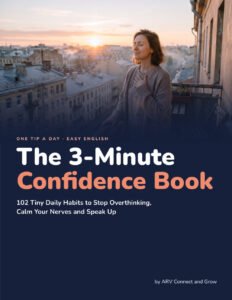
102 Tiny Daily Habits to Stop Overthinking, Calm Your Nerves and Speak Up.

92 three-minute tips for calmer days with people.
This is what a tip looks like inside a lesson. Read it. Press play to listen in English. Tap the arrow to read the full text. Then ask Ava anything about it.

The longer you wait, the bigger the moment feels. When you notice a chance to say hello, take it within a few seconds, before the doubts arrive.
Here's a simple truth about shyness. The longer you wait to say hello, the bigger the moment feels. A hello that takes one second at the start can feel impossible after one minute of thinking about it.
So this tip is about speed, not courage. When you notice a chance to say hello, say it within about three seconds. That is before your mind has time to build a story about everything that could go wrong.
Your brain is very good at protecting you. When you hesitate, it starts listing reasons to stay quiet. What if they ignore me? What if I sound strange? Every second of waiting gives those thoughts more power.
A fast hello skips that whole argument. It also feels lighter to the other person. A quick Hi sounds friendly and relaxed. A hello that arrives late, after a long pause, can sound serious, and then both of you feel the pressure.
Imagine you're in line at a coffee shop. The person next to you is looking at the menu, and you notice a bright yellow backpack. Your first thought is, I could say something about the backpack. Now count to three, and do it.
You: Hi! I love your backpack.
Them: Oh, thanks! I got it on a trip last summer.
You: Nice. Where did you go?
That's the whole thing. One short hello, one honest comment, and one easy question. In ten seconds, you've started a real conversation. Notice that you didn't need a clever line.
Here's a second example, at work. You see a new colleague in the kitchen. Instead of waiting for the perfect moment, you say, Hi, I'm Sam. Are you new on the team? Even if the chat is short, you've turned a stranger into someone familiar.
Today, choose three small chances to say hello. A neighbor, a cashier, someone at the gym. Say Hi within three seconds of noticing the chance. You don't have to say anything more.
If your heart beats fast, that's normal. Take one slow breath, smile, and say it anyway. It gets easier every time you do it.
Many people wait for the perfect first line. There isn't one. A simple Hi or Good morning works better than a clever sentence you've rehearsed for five minutes.
So remember this. Notice the chance, count to three, and say hello. Then let the conversation grow from there.

When you feel nervous, your speech gets faster, and you often do not notice. Knowing this is the first step to fixing it. Nerves push you faster, so choose slower on purpose.
When you feel nervous, your speech gets faster, and you often do not notice.
Knowing this is the first step to fixing it.
When we feel stress, the body releases adrenaline. Your heart beats faster, your breathing gets shorter and quicker, and your muscles get ready to act. Speech is a muscle activity, so it speeds up too. The mind wants to finish the scary thing as fast as possible, so the words tumble out.
The problem is that fast speech makes you sound more nervous, and that makes you feel more nervous. It becomes a loop. The way out is to slow down on purpose. When you slow your speech and your breathing, you send a message to your body that all is well. The calm voice comes first, and the calm feeling often follows.
Dale Carnegie wrote that you cannot always remove fear, but you can learn to act well in spite of it.
Many speaking coaches, including those behind Talk Like TED by Carmine Gallo, advise speakers to slow the opening and breathe, because nerves push the pace up.
Imagine your heart is racing as you start to speak.
You: Slower than feels natural. Slower than feels natural.
(You say the reminder in your head, and your first sentence comes out steady.)
Now imagine you are telling a story to new people and notice you are rushing.
You: Let me start that part again, a bit slower.
(You smile, take a breath, and the group leans in.)
Step one. Before you speak, tell yourself, 'Slower than feels natural.'
Step two. Take one slow breath out before your first word.
Step three. Check at the end of each sentence. If you are rushing, ease down.
If you forget the reminder, write it on a card or in the corner of your notes.
If your heart is still racing, do not fight it. Breathe out slowly and carry on at a steady pace.
Some people try to speak fast to get it over with. This makes the words blur.
A short, clear talk at a steady pace ends sooner than a rushed one you have to repeat.
So remember this. Nerves push you faster, so choose slower on purpose.

In every room there is usually someone standing a little apart. That person is often the best one to talk to, because they are very likely to welcome you.
In every room there's usually someone standing a little apart. They check their phone, they study the food, and they glance at the door. That person is often the best one to talk to, because they're very likely to welcome you.
Learning to notice them is a kind habit, and it makes meeting people much easier.
A person who stands alone is often hoping for company but is too nervous to ask. Approaching them removes the worry of breaking into a busy group. They're usually relieved and grateful, and they tend to remember who made them feel included.
Groups can be harder to join, because you must read the mood and wait for a gap. One person is much simpler. You need only one hello and one question.
Kwame arrived at a work party and saw a young man standing quietly near the window. He walked over and said, I'm Kwame, I don't know many people here either. The young man laughed with relief.
He turned out to be a new colleague from another office, and he introduced Kwame to four people he already knew. Kwame says that a lonely corner often leads to the warmest conversation of the night.
At your next event, spend the first few minutes looking for someone alone. Walk over with a gentle smile and say something simple like, hi, is this your first time here.
If you feel shy, tell yourself that you're doing them a kindness. That thought can make walking over feel generous rather than frightening.
A person standing alone isn't a problem. They're an opportunity for you both.
Here is the tip in a few words. Learning to notice them is a kind habit, and it makes meeting people much easier. Take it slowly, and be kind to yourself as you learn. Small steps are more than enough.
At your next gathering, find one person who is alone and go and say hello.

You may think you are not a salesperson. But you talked a friend into a new restaurant and told your boss why your idea is good. That is selling.

A good introduction fits in one breath. A helpful rule is to keep it under fifteen words. Short lines are easy to say, easy to hear and easy to remember.
A good introduction fits in one breath. A helpful rule is to keep it under fifteen words. Short lines are easy to say, easy to hear and easy to remember. They also leave space for the other person to answer.
If your line is longer, it's probably holding more than one idea.
Our short-term memory can hold only a small amount of information at a time. A fifteen-word sentence is about the right size for a listener to follow without effort.
Brevity also shows confidence. People who speak briefly sound sure of themselves, and listeners relax.
Ravi had a forty-word introduction that he was proud of. At events, people's eyes glazed over before he finished. A friend counted the words and smiled.
They worked together to shorten it. The result was, I help local shops sell more, with simple online tools. Eleven words. At the next event, a shop owner said, I need exactly that, and gave him her card. Ravi says that cutting words was hard, but that it made his message shine.
Write your introduction, and count the words. If it's over fifteen, remove anything that isn't needed. Read it aloud to check that it fits in one breath.
If every word feels important, keep the ones that carry the result and the people. The rest can wait for later in the conversation.
Short is kind. It respects the listener's time, and it gives your words room to land. Every extra word is a small weight, so keep only what helps.
You can also shorten by choosing stronger words. One clear verb is better than three soft ones. Instead of, I'm involved in helping with, say, I help. Every small cut makes your line lighter, and it leaves more room for a smile.
Count the words in your introduction. Cut it to fifteen or fewer, and say it aloud twice.

There is a voice in your head that talks to you all day. It comments, it judges, and sometimes it is cruel. Today’s tip is simple. Just notice it.
Meet People · Dating & Events
Find someone who gets you.
Real people, real conversations. You choose who sees you.
Meet up. Make memories.
Coffee meetups, hikes and game nights near you. Or host your own.
Hosting is free. Every new event is checked by our team to keep everyone safe.
Practical lessons for real-life situations — from networking to public speaking and everything in between.

See what changes when you invest in your people skills.
Everything you need to speak up, connect and grow, in one place.
Audio tips in English
Real-life examples
Exercises to try today
Learn at your own pace
Ask Ava, your AI helper
Automatic translation in 20+ languages
Better communication can create better friendships, stronger relationships, more confidence, and more opportunities.
No credit card required.
Fresh, free lessons with 40 easy tips and audio on every tip.


ARV Connect & Grow is a learning platform that teaches practical people skills — communication, confidence, friendship and sales — through short lessons, real examples and exercises.
Anyone who wants to feel more confident with people: professionals, students, entrepreneurs, sales teams and anyone who wants deeper relationships.
Create a free account on the Get Started page. You can explore the topic guides right away.
Step-by-step lessons, tips, real-life examples and practical exercises for every topic, with more videos and resources added regularly.
Yes. You can cancel any paid membership at any time.
Yes — a supportive community of members who practice together and share their progress.
Notifications
